
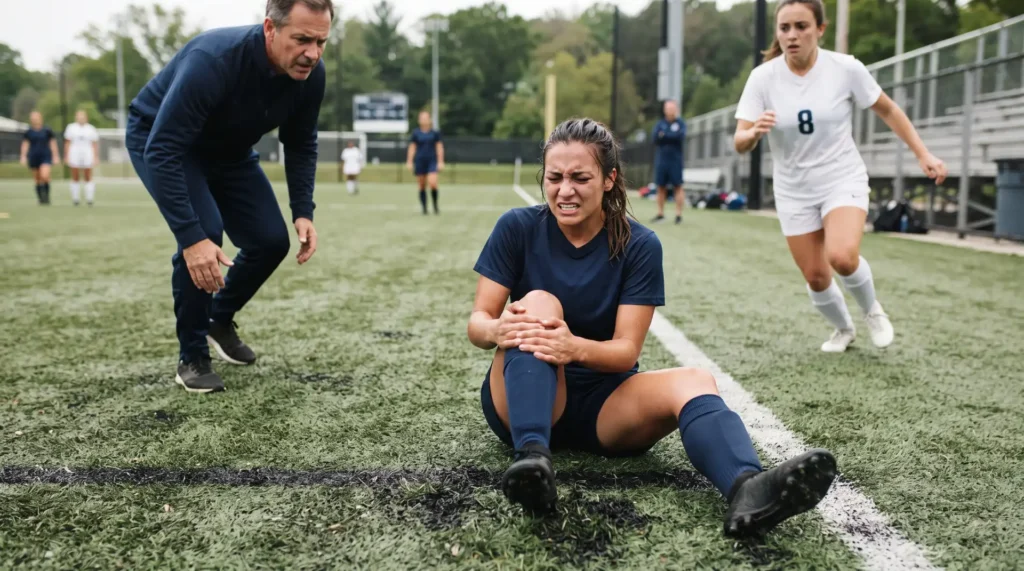
Artificial turf has become an important part of the American sports landscape. High schools, colleges, universities, municipalities, professional organizations, private athletic complexes, indoor sports centers, and youth sports programs use synthetic playing surfaces for football, soccer, lacrosse, baseball, field hockey, and other activities.
There are several reasons facilities choose artificial turf. Synthetic surfaces can withstand frequent use and may allow athletes to practice and compete when natural grass would be difficult to maintain. A busy sports complex may have multiple teams using the same field throughout the week, making durability an important consideration.
However, an artificial surface is not automatically a safe surface.
Like natural grass, synthetic turf can deteriorate, develop damaged seams, become uneven, lose infill, experience drainage problems, or develop other conditions that may affect how athletes interact with the playing surface. The age of the field, maintenance program, weather, frequency of use, installation quality, footwear, and sport can all influence the conditions athletes encounter.
The relationship between artificial turf and athletic injuries has also been examined in sports medicine research. A CDC-indexed study involving collegiate football players reported an association between artificial turf and lower-extremity injury risk in the population studied. That type of research does not mean every artificial turf field is dangerous or that artificial turf automatically causes an injury. Instead, it illustrates why playing-surface conditions can be relevant when evaluating athletic injuries.
From a legal perspective, the question is usually more specific than simply asking whether an athlete was injured on artificial turf.
The important questions can include what condition the field was in, whether the condition was dangerous, who owned or controlled the facility, who was responsible for maintenance, whether someone knew or should have known about the problem, whether appropriate warnings were provided, and whether the condition contributed to the athlete’s injury.
What Are Artificial Turf Injuries?
Artificial turf injuries can affect virtually any part of an athlete’s body. Lower-extremity injuries are particularly important because athletes constantly rely on their feet, ankles, knees, and hips when sprinting, stopping, jumping, landing, cutting, and changing direction.
A soccer player may plant one foot before making a rapid turn. A football player may accelerate and suddenly cut around an opponent. A lacrosse player may pivot while carrying the ball. A field hockey player may move quickly while maintaining a low center of gravity.
These movements place substantial forces on the body.
When the playing surface behaves differently from what the athlete expects, the movement can become unstable. A foot may become stuck, slip unexpectedly, land on an uneven area, or encounter a different level of resistance than anticipated.
The resulting injury may involve a ligament, tendon, muscle, bone, joint, or other structure.
Artificial turf can also cause significant abrasions when an athlete falls or slides. These injuries are commonly described as turf burns. Although abrasions may initially appear less serious than a torn ligament or broken bone, deeper wounds can be painful and may require medical attention.
An athlete who falls unexpectedly can also suffer a concussion or other head injury, depending on the circumstances. Shoulder, elbow, wrist, and hand injuries may occur when a player instinctively uses the upper body to break a fall.
The existence of an injury does not automatically mean that the field was defective or that someone else is legally responsible. Sports inherently involve certain risks, and athletes can be injured even on properly maintained playing surfaces.
The legal question becomes more complicated when the injury allegedly results from an unsafe condition that could have been identified or corrected.
When Can Artificial Turf Become Unsafe?
Artificial turf is designed to provide a relatively consistent playing surface, but its condition can change over time.
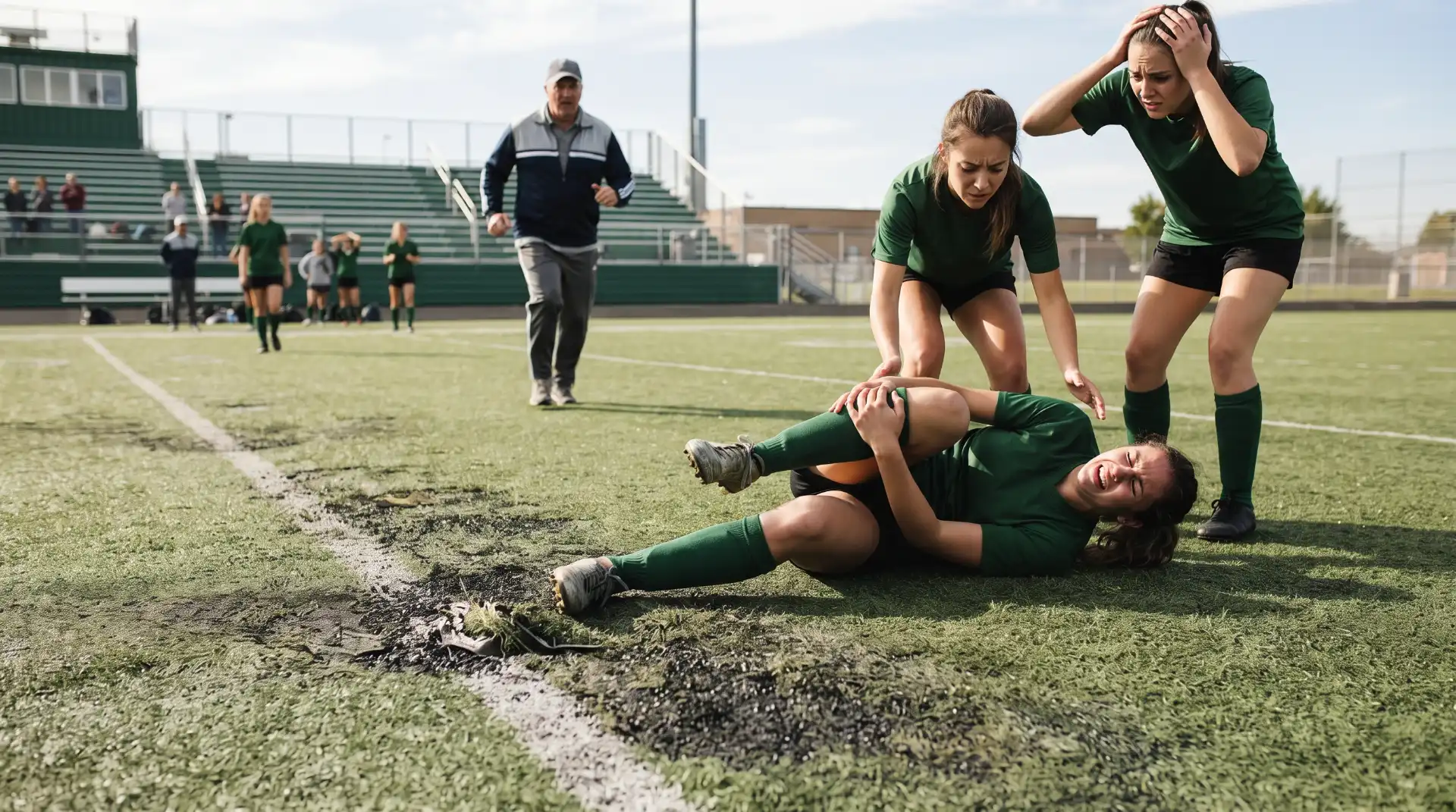
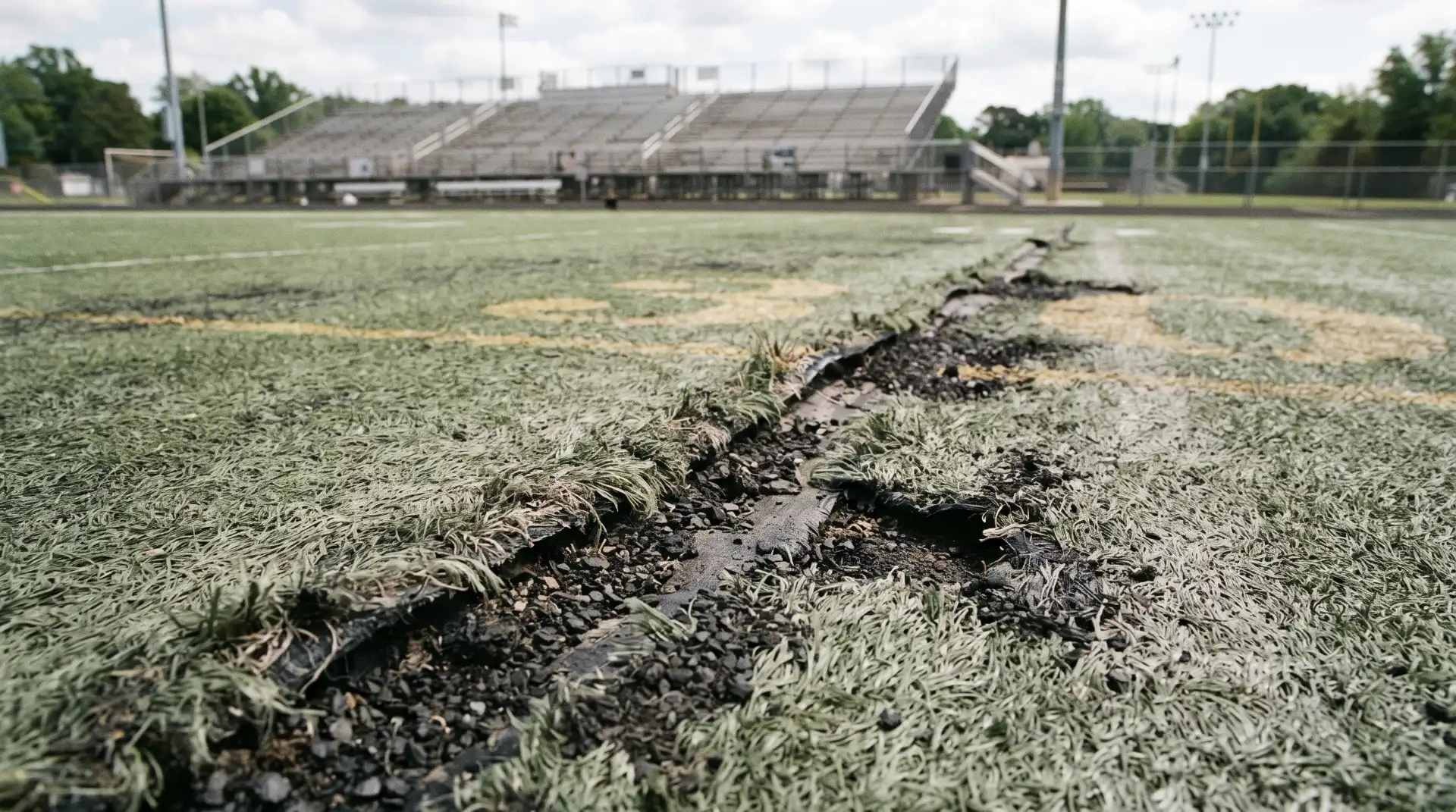
Repeated use can wear down turf fibers. Heavy athletic activity can affect infill distribution. Seams can deteriorate. Areas of the field may become uneven. Drainage can become less effective. Repairs may fail or create transitions between different sections of the surface.
The underlying surface can also matter. Artificial turf is not simply a layer of synthetic grass. It is part of a larger system involving the base beneath it, drainage, infill, seams, installation, and maintenance.
A problem with one component may influence the way the entire surface performs.
For example, an uneven section may cause an athlete’s foot to land at an unexpected angle. A damaged seam may create a transition that catches a cleat. Excessive or inadequate infill may affect how an athlete’s foot interacts with the surface.
These conditions may become more significant when athletes are moving at high speeds.
However, the legal significance of a particular condition depends on the circumstances. A minor imperfection that does not create an unreasonable danger may not establish negligence. A serious defect that is known to a facility operator and remains unrepaired may raise different questions.
That distinction is important when evaluating an artificial turf injury.
Worn Turf and Changes in Traction
Athletes depend on predictable traction.
A football player accelerating from a stationary position needs the foot to interact with the surface in a consistent way. A soccer player cutting at speed depends on predictable resistance from the ground. A basketball player needs a stable surface for jumping and landing.
Unexpected traction can create problems.
If an athlete expects the foot to slide slightly but instead experiences unusually strong resistance, the body can rotate around a planted foot. Conversely, if an athlete expects strong traction but encounters a slippery section, the foot may move unexpectedly.
Neither situation automatically means the field was unsafe. Traction is affected by numerous variables, including footwear, moisture, surface materials, temperature, and the athlete’s movement.
But if the condition results from a known maintenance problem, the history of that condition may become relevant to a liability investigation.
Uneven Surfaces Can Increase Injury Concerns
Artificial turf should provide a playing surface appropriate for the sport for which it was installed and maintained.
Uneven areas can become particularly concerning when athletes are running quickly.
A small change in elevation may not be noticeable while walking. An athlete sprinting across the field may have much less time to respond.
A foot landing on an unexpected depression or raised area can alter the position of the ankle, knee, or hip. If the athlete is simultaneously rotating, accelerating, or attempting to avoid another player, the body may not have enough time to compensate.
The result can be an ankle sprain, knee injury, muscle strain, fall, or more serious trauma.
The precise cause still needs to be established. Athletes can experience the same injuries because of ordinary athletic movements. Therefore, an investigation should examine whether the surface condition actually contributed to the incident rather than assuming that it did.
Common Injuries Associated With Problematic Artificial Turf
Knee Injuries
Knee injuries are among the most significant injuries an athlete may suffer after an unexpected movement on a playing surface.
The ACL, or anterior cruciate ligament, is particularly important in sports involving jumping, landing, cutting, and rapid changes in direction. An athlete can tear the ACL during a noncontact movement when the lower body and upper body move in different directions.
Meniscus injuries and other ligament injuries can also occur.
Your AthleticInjuries.net article on ACL Injury Prevention in Female Athletes: Latest Evidence and Drills provides additional information about ACL risk factors, neuromuscular training, strength, balance, landing technique, and agility.
A serious knee injury may require surgery and months of rehabilitation. Even after physical healing, an athlete may need extensive strength, movement, and return-to-sport testing before competition.
Ankle Injuries
Ankle sprains are common in athletic environments.
A sudden change in footing can cause the ankle to roll or twist. Depending on the severity, an athlete may experience pain, swelling, bruising, instability, and difficulty putting weight on the affected leg.
Some athletes return to competition too quickly after an ankle injury. Inadequate rehabilitation may leave the joint unstable and increase the possibility of future problems.
Muscle and Tendon Injuries
Hamstring strains, calf injuries, Achilles tendon problems, and other soft-tissue injuries may also occur during sudden acceleration or changes in direction.
It is important not to automatically attribute every muscle injury to artificial turf. Athletes can develop these injuries for many reasons, including fatigue, inadequate conditioning, previous injuries, training load, movement mechanics, and ordinary athletic activity.
The condition of the field may be one factor that should be investigated when the circumstances suggest a connection.
Fractures and Dislocations
An unexpected fall can result in fractures or dislocations involving the ankle, wrist, shoulder, elbow, or other areas.
A severe injury may require emergency treatment, imaging, immobilization, surgery, and extended rehabilitation.
The seriousness of the injury does not by itself establish legal responsibility. Liability depends on the applicable law and the facts surrounding the incident.
Turf Burns and Abrasions
Sliding or falling across synthetic turf can produce abrasions ranging from minor skin irritation to deeper wounds.
Athletes who play sports involving frequent contact with the surface may be particularly familiar with turf burns.
While these injuries are often temporary, deep abrasions can require medical care and may become infected if not properly treated.
Can an Unsafe Artificial Turf Field Lead to Liability?
Potentially, but the answer depends on the facts and the law of the state where the injury occurred.
A sports field may be part of a property owned by a public school, private school, college, university, municipality, private sports company, youth league, or another organization.
Different parties may have different responsibilities.
The owner may be responsible for the property. A tenant may control the facility. A maintenance company may be responsible for inspecting and repairing the turf. A league may have contractual responsibilities concerning field preparation.
Determining liability therefore requires more than identifying who owns the field.
Investigators may need to determine who controlled the surface at the time of the injury and who had responsibility for discovering and correcting unsafe conditions.
How Negligence Can Apply to Sports Fields
Negligence generally involves a legal duty, a breach of that duty, a connection between the breach and the injury, and legally recognized damages. The exact requirements vary among states.
For example, imagine that a facility’s employees repeatedly observe a damaged section of artificial turf. Written maintenance records document the problem, but the facility continues allowing full-speed practices and games without repairing the area or providing an appropriate warning.
If an athlete later suffers an injury because of that condition, the maintenance history could become relevant to a negligence claim.
That does not mean liability is automatic. The claimant would still need to satisfy the applicable legal requirements.
Now consider a different situation. An athlete suffers an ankle sprain while making an ordinary cut on a properly maintained field, with no evidence of a defect or dangerous condition.
The injury itself would not establish that the facility was negligent.
This distinction between ordinary athletic risk and an allegedly unsafe condition is extremely important.
Who May Be Responsible for an Artificial Turf Injury?
Several parties may potentially become relevant depending on the circumstances.
Schools and Universities
Schools may own or control athletic fields. If an injury occurs during school-sponsored athletics, the school’s responsibilities may need to be examined.
Public schools may be subject to governmental-immunity rules or special claim procedures, while private institutions may operate under different legal frameworks.
Municipalities and Recreation Departments
Cities, counties, and other public entities frequently operate community sports facilities.
Government-owned property can involve special legal requirements, including different notice procedures and limitations on liability.
Private Sports Facilities
Private athletic complexes may rent fields to youth leagues, adult leagues, schools, and other organizations.
Contracts can determine which party is responsible for maintenance, field preparation, inspections, and repairs.
Maintenance Contractors
A facility may hire a third-party company to maintain its artificial turf.
Maintenance records, inspection reports, work orders, and communications with contractors may become important when determining who knew about a problem and what actions were taken.
Manufacturers and Installers
In some cases, the alleged problem may involve the turf product or installation itself.
That could raise product-liability or construction-related questions rather than a traditional premises-liability claim.
The Importance of Notice
One important question in an unsafe-field investigation is whether the responsible party knew about the dangerous condition.
Actual notice may exist when someone directly reports the problem.
A coach might report a damaged section of turf. An athletic trainer may document an unsafe area. A maintenance worker may discover a problem during an inspection. Parents or athletes may submit complaints.
Constructive notice involves a different concept. Depending on state law, a dangerous condition may have existed long enough or been sufficiently apparent that the responsible party should reasonably have discovered it.
The exact rules differ significantly between jurisdictions.
That is why records from before an accident can become valuable evidence.
What Evidence Should Be Preserved?
Evidence can disappear quickly after a sports-field accident.
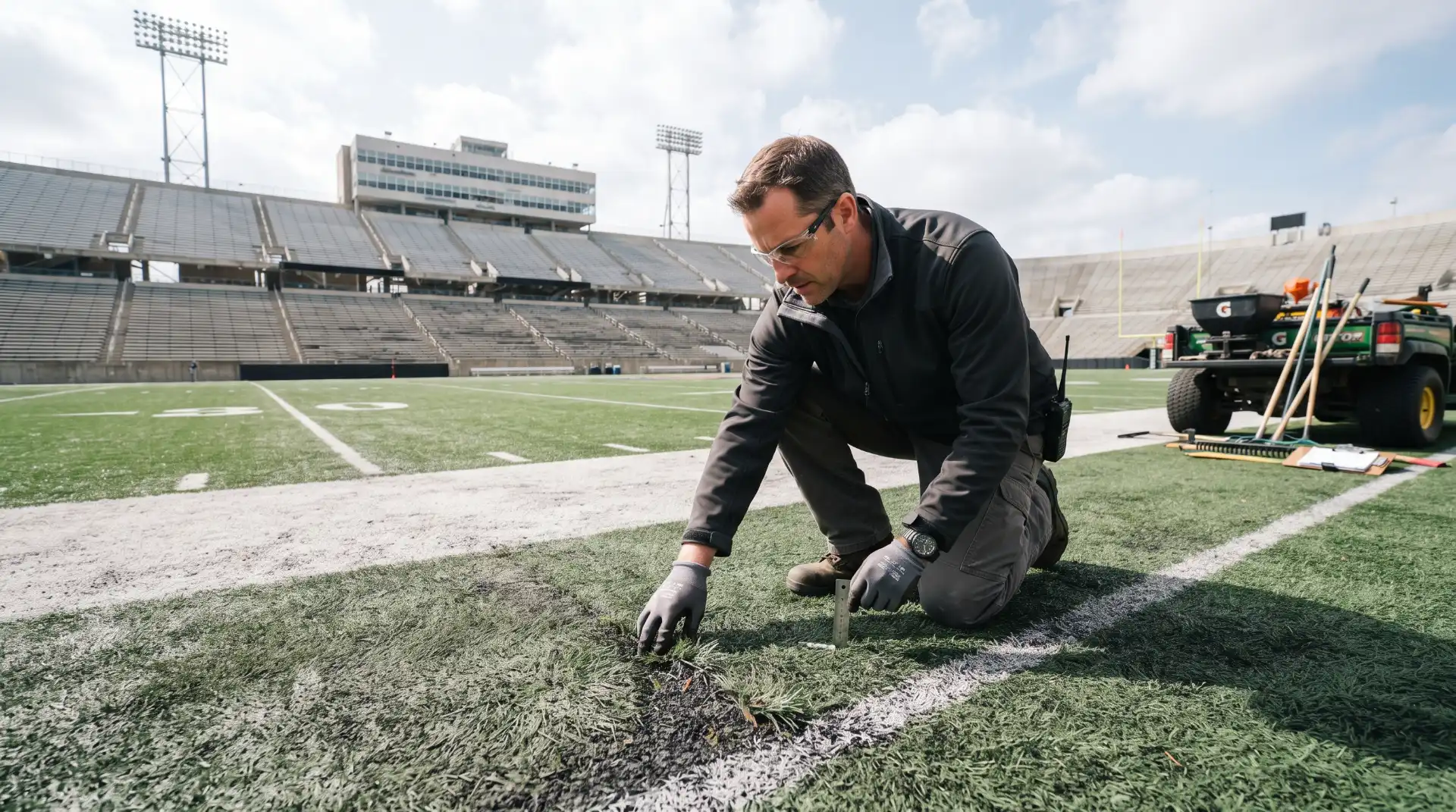
Photographs of the field can help document its condition. If the turf is repaired shortly after an accident, photographs taken before the repair may become particularly important.
Athletes and parents should also record the exact location of the incident.
Witness information can be useful. Teammates, coaches, referees, athletic trainers, facility workers, and spectators may have seen the accident or noticed the field condition.
Medical documentation is equally important.
Emergency-room records, diagnostic imaging, orthopedic evaluations, physical therapy records, surgical reports, medication records, and rehabilitation notes can document the nature and progression of an injury.
Maintenance records may also provide valuable information. These can include inspection logs, work orders, repair records, contractor invoices, field-use schedules, and previous complaints.
Can a Sports Waiver Prevent a Claim?
Many sports programs require participants or parents to sign waivers before participating.
A waiver may affect a legal claim, but its effect depends on the language of the agreement and the law of the state involved.
Athletes generally understand that ordinary sports involve risks such as collisions, falls, awkward landings, and contact with other players.
That does not necessarily mean every possible danger associated with a facility is automatically considered an ordinary risk.
There may be an important distinction between accepting the inherent risks of playing soccer and encountering a hidden or unusually dangerous condition that a facility operator allegedly failed to address.
Waiver law varies considerably across the United States. Minors may also create additional legal considerations because parents or guardians frequently sign participation agreements on their behalf.
A signed waiver should therefore be reviewed in the context of the specific incident rather than assumed to either eliminate or guarantee a legal claim.
Artificial Turf and Heat Exposure
Heat is another consideration for outdoor athletic facilities.
Artificial turf fields are frequently used during summer practices, preseason camps, and tournaments. Athletes exercising outdoors during hot conditions can face increased risks of dehydration and heat-related illness.
The CDC recommends that athletes take precautions during hot weather, including scheduling workouts when conditions are cooler when possible, pacing activity, drinking water, monitoring teammates, and stopping activity if symptoms such as weakness or faintness occur.
For more information, see the CDC’s Heat and Athletes resource.
Heat is not the same as a defective turf condition, but it can be part of the broader safety environment surrounding an athletic facility.
Extreme temperatures may also affect how athletes perform. Fatigue can change running mechanics, balance, reaction time, and decision-making.
Facility operators, coaches, and athletic programs should therefore consider environmental conditions in addition to the physical condition of the playing surface.
Youth Athletes and Artificial Turf Injuries
Artificial turf is widely used for youth sports throughout the United States.
Children and teenagers may play on synthetic fields at schools, recreation centers, club facilities, soccer complexes, and private athletic facilities.
A serious injury during adolescence can have consequences beyond the immediate medical treatment.
A student may miss school, lose the ability to participate in a season, require transportation to medical appointments, or experience a lengthy rehabilitation period.
Parents may also face medical expenses and other costs associated with treatment.
Young athletes may feel pressure to return quickly because they do not want to lose a position or disappoint their team.
That pressure can make appropriate medical evaluation particularly important.
Your article on Signs of Overtraining in Young Athletes and How to Avoid Burnout discusses how excessive training and inadequate recovery can contribute to physical problems, declining performance, and burnout among young athletes.
Field safety and athlete recovery are different issues, but both are important components of a safe youth-sports environment.
Returning to Sports After a Turf Injury
The treatment of an artificial turf injury depends on the injury itself.
An athlete with a minor abrasion may recover quickly, while an athlete with an ACL tear may require surgery and many months of rehabilitation.
Returning to sports should not be based solely on how many weeks have passed.
Your article on Return to Sport Testing After a Serious Athletic Injury explains why return-to-sport decisions can involve strength, mobility, movement quality, endurance, confidence, and sport-specific performance.
This is particularly important after injuries involving the knee, ankle, hip, shoulder, or other structures that must tolerate high athletic loads.
An athlete may be able to walk normally but still have difficulty sprinting, landing, cutting, or changing direction.
Returning too quickly may also create additional physical or psychological challenges.
How Sports Facilities Can Reduce the Risk of Turf-Related Injuries
Sports organizations can take practical steps to maintain safer athletic environments.
Regular inspections can help identify worn areas, damaged seams, uneven sections, drainage concerns, and other problems before they become more significant.
Maintenance should also be documented.
A detailed inspection record can show when the field was examined, what was discovered, who performed the work, and what repairs were completed.
Facilities should also have a system for reporting concerns.
Athletes, parents, coaches, athletic trainers, referees, and employees may notice problems at different times. A clear reporting process gives the organization an opportunity to identify and address concerns before an injury occurs.
When a serious defect is discovered, restricting access to the affected area may be appropriate until the problem can be evaluated and corrected.
Maintenance contractors should also understand the manufacturer’s maintenance recommendations and the facility’s expected usage.
The goal is not to eliminate every possible sports injury. Athletic participation will always involve inherent risks.
The goal is to prevent injuries caused by avoidable hazards.
Why Maintenance Records Matter
Maintenance records can provide a timeline of a field’s condition.
Suppose a facility replaces artificial turf after several years of use. The replacement records may establish when the original field was installed and how long it remained in service.
Inspection records can show whether regular checks were conducted.
Repair records can establish whether previous defects were identified.
Complaint records can show whether athletes, coaches, parents, or employees reported concerns.
These documents may become particularly important when there is a dispute over whether a facility knew about a hazardous condition.
The absence of records does not automatically establish negligence, and the existence of records does not automatically prove that a facility acted properly. Their significance depends on the facts and applicable law.
Product Liability and Artificial Turf
Some artificial turf injury cases may involve allegations about the turf product itself.
For example, an investigation could examine whether a particular product was manufactured incorrectly, designed improperly, installed incorrectly, or accompanied by inadequate warnings or instructions.
Product-liability cases can involve manufacturers, distributors, sellers, installers, or other parties depending on the circumstances.
These cases can be technically complex.
Experts may need to examine the turf, infill, underlying base, installation process, maintenance records, manufacturer specifications, and the circumstances of the injury.
A product being associated with an injury does not automatically establish that the product was defective.
The specific defect and its connection to the injury generally need to be established through evidence.
What Should an Athlete or Parent Do After a Serious Turf Injury?
The first priority is appropriate medical care.
An athlete should be evaluated by a qualified healthcare professional when the injury causes significant pain, swelling, instability, inability to bear weight, deformity, loss of function, or other concerning symptoms.
After immediate medical concerns are addressed, preserving information about the incident can be useful.
Write down what happened while the details are still fresh. Record the date, time, facility, field, approximate location, activity being performed, and people who witnessed the incident.
Photograph the field condition if it can be done safely.
Photograph visible injuries as appropriate.
Keep copies of medical records, bills, prescriptions, physical therapy documentation, and other treatment-related information.
If the facility creates an incident report, request information about the process for documenting the accident.
Avoid changing or repairing evidence yourself.
If the injury is serious or may have long-term consequences, an attorney familiar with sports injuries and the applicable state law can explain potential legal options.
What Compensation May Be Available?
If a claimant establishes legal responsibility, the damages available can depend on the law of the applicable state and the facts of the case.
Medical expenses may include emergency care, diagnostic testing, surgery, hospitalization, physical therapy, rehabilitation, prescription medications, and future treatment.
Lost income may be relevant when an adult athlete is unable to work because of an injury.
Pain and suffering may also be considered under applicable law.
A serious athletic injury can affect an athlete’s ability to participate in sports and recreational activities. In some cases, it can affect employment or education as well.
Future medical needs may be particularly important when an injury produces permanent limitations.
The calculation and availability of damages vary significantly by jurisdiction. Claims involving government-owned facilities may also be subject to special limitations and procedures.
Artificial Turf Does Not Automatically Mean an Unsafe Field
It is important to distinguish between the existence of artificial turf and the existence of an unsafe field.
Synthetic turf is used successfully by athletic programs throughout the United States.
Many athletes practice and compete on artificial surfaces without suffering injuries caused by the surface.
The fact that an injury happened on artificial turf does not prove that the turf caused it.
An athlete can tear an ACL on a properly maintained field. A soccer player can sprain an ankle during an ordinary cut. A football player can suffer a shoulder injury during normal contact.
These are inherent possibilities associated with athletic participation.
The legal analysis changes when there is evidence that an unusual condition contributed to the accident.
A damaged seam, significant unevenness, failure to address a known defect, improper maintenance, or another hazardous condition may warrant further investigation.
The Importance of Identifying the Exact Cause
One of the most important aspects of an artificial turf injury investigation is determining exactly what happened.
Consider a soccer player who changes direction and suffers a knee injury.
If the athlete’s foot remained in a normal position and there was no unusual surface condition, the injury could be an ordinary sports injury.
Now consider an athlete whose cleat catches on a damaged seam that had reportedly been present for weeks.
The two injuries could involve the same body part, but the circumstances are completely different.
That is why a strong investigation should focus on the sequence of events.
What was the athlete doing?
What did the athlete’s foot contact?
What did the field look like?
Had the condition previously been reported?
Who maintained the field?
Was the field inspected?
Was a repair attempted?
Was the athlete warned?
Was the field being used in a manner consistent with its intended purpose?
The answers can help establish whether the playing surface was merely the location of an accident or whether a condition associated with the facility contributed to the injury.
Frequently Asked Questions About Artificial Turf Injuries
Can artificial turf cause sports injuries?
Artificial turf can be associated with athletic injuries, but it would be inaccurate to conclude that every artificial turf surface is dangerous. Injury risk depends on many factors, including the sport, athlete, footwear, surface condition, weather, maintenance, and type of movement.
Can I sue a school if I was injured on artificial turf?
A claim may be possible in some circumstances, but it depends on the facts and applicable state law. Public schools may be subject to governmental-immunity rules and special filing requirements that differ from claims involving private schools.
Does a damaged turf field automatically mean the facility was negligent?
No. A damaged field can be important evidence, but additional questions usually must be answered concerning duty, notice, breach, causation, and damages.
What should I do if the field was repaired after my accident?
Document the original condition as soon as possible through photographs, videos, witness information, incident reports, and other available evidence. The fact that the field was later repaired does not by itself establish liability.
Can a waiver prevent an artificial turf injury claim?
A waiver may affect a claim depending on its language and the applicable law. However, the legal effect of a waiver varies between states and circumstances.
Can the company that installed the turf be responsible?
Potentially, depending on the circumstances. If improper installation or another construction-related problem contributed to the injury, the installer or contractor may become relevant to the investigation.
Can a turf manufacturer be responsible?
Potentially, if evidence supports a product-liability claim involving a defective product or inadequate warning. Such cases often require technical evidence and careful examination of the product and installation.
Should athletes stop playing after a serious turf injury?
An athlete with a serious injury should seek appropriate medical evaluation. Continuing to play through significant pain, instability, swelling, or loss of function may make recovery more difficult.
Final Thoughts on Artificial Turf Injuries and Sports Field Liability
Artificial turf has become a major part of sports facilities throughout the United States. It offers practical benefits for schools, municipalities, professional organizations, private sports complexes, and youth leagues, but synthetic turf still requires appropriate inspection, maintenance, repair, and oversight.
When an athlete suffers an injury on an artificial surface, the presence of turf alone does not establish negligence or legal responsibility.
The more important issue is what caused the injury.
A serious investigation may examine the physical condition of the field, maintenance history, inspection records, previous complaints, ownership, control, contracts, warnings, weather, footwear, the athlete’s movements, and the exact sequence of events.
The potential parties can also vary. A school, university, municipality, private sports facility, maintenance contractor, installer, manufacturer, or another organization may become relevant depending on the circumstances.
Athletes and parents should also remember that legal rules differ throughout the United States. Premises-liability standards, assumption-of-risk rules, comparative-fault laws, governmental immunity, product-liability requirements, and filing deadlines can vary significantly from one state to another.
For that reason, a serious artificial turf injury should be evaluated based on the specific facts and the law applicable to the location where the accident occurred.
From a safety perspective, sports facilities can reduce preventable risks by maintaining inspection programs, documenting repairs, responding to reported hazards, following appropriate maintenance procedures, and taking environmental conditions into account.
From an athlete’s perspective, appropriate medical treatment and rehabilitation should remain the first priority.
When an injury is serious, preserving evidence can also be important. Photographs, witness information, medical documentation, incident reports, and maintenance records may help establish what happened.
Artificial turf itself is not necessarily the problem. The important question is whether the specific surface was properly maintained and reasonably safe for the activity taking place on it.
A well-maintained field can still be the site of an ordinary athletic injury. An improperly maintained field, however, may raise additional questions when an unusual or dangerous condition contributes to an accident.
Understanding that difference can help athletes, parents, coaches, and facility operators better understand the safety and legal issues surrounding artificial turf injuries in the United States.
Disclaimer: This article is provided for general educational and informational purposes only. It is not legal advice, does not create an attorney-client relationship, and should not be relied upon as a substitute for advice from a qualified attorney familiar with the applicable state law. Medical information in this article is also general in nature and does not replace evaluation or treatment by a qualified healthcare professional.